Classic Shelf
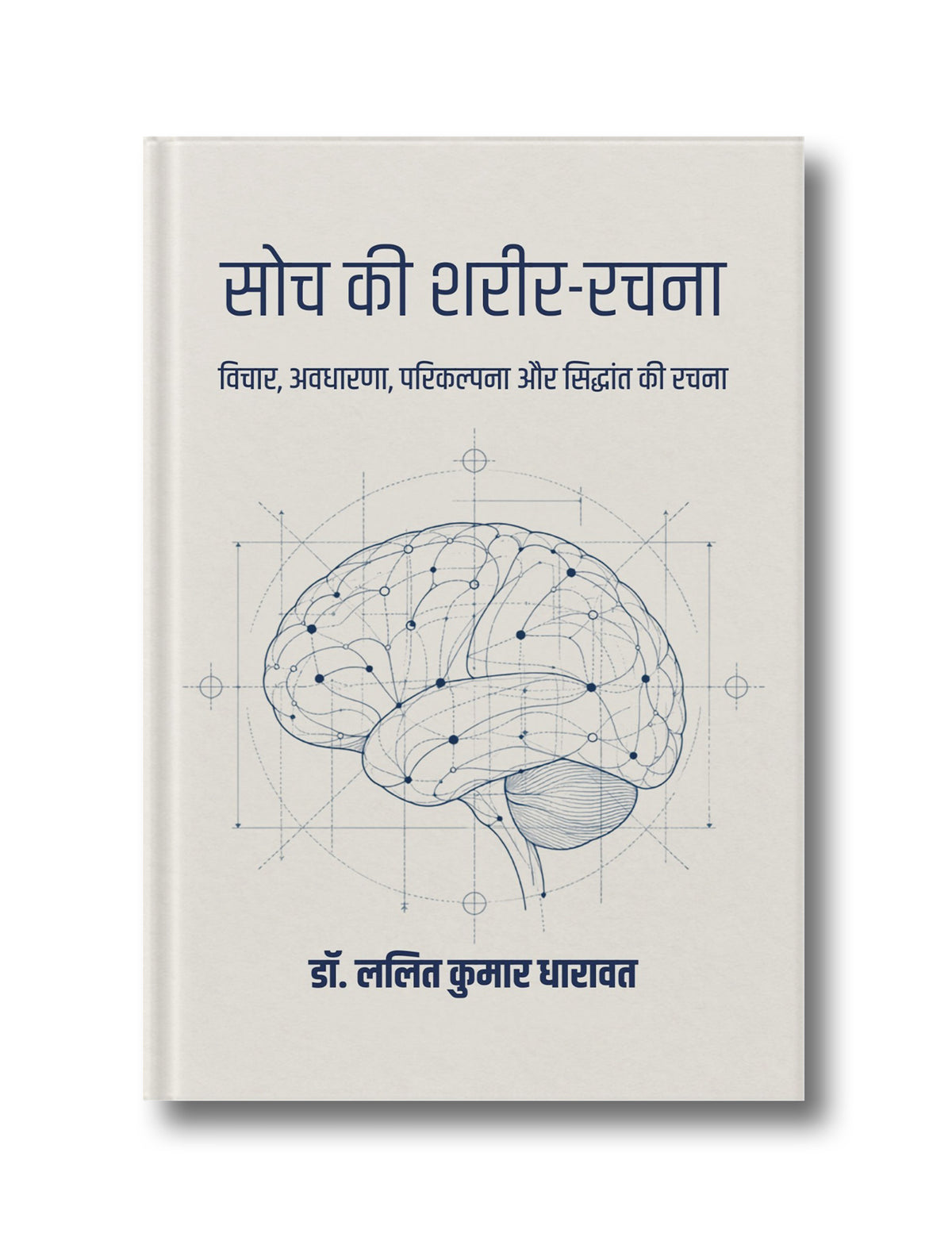
Soch ki Sharir Rachna: Vichar, Avdharna, Parikalpana Or Siddhant Ki Rachna
Soch ki Sharir Rachna: Vichar, Avdharna, Parikalpana Or Siddhant Ki Rachna
Couldn't load pickup availability
About The Book
Soch ki Sharir Rachna: Vichar, Avdharna, Parikalpana or Siddhant Ki Rachna unlocks the master blueprint of human intelligence, tracing the extraordinary journey of how a single, fleeting spark in the brain evolves into a universally accepted law of reality. This work delivers a masterclass in cognitive architecture, explicitly charting the systematic evolution of human knowledge. Tailored for a global audience of intellectuals, students, and cognitive scientists, this book answers a fundamental question: How does a fleeting spark of inspiration transform into a universally accepted framework of reality? By mapping this exact mental journey, the book synthesises insights from philosophy, cognitive psychology, and epistemology into a single, globally applicable model of human intelligence.
To understand the mind, one must follow its structure. The book’s core thesis relies on a rigorous, step-by-step cognitive hierarchy. Each stage serves as the logical prerequisite for the next:
Ideas: The foundational spark. These are the raw, unrefined currencies of imagination, born from spontaneous neurological synthesis. However, a raw idea lacks form.
Concepts: The structural unit. To become useful, an idea must be categorised, given language, and assigned boundaries. Concepts group these raw ideas into recognisable mental buckets.
Hypotheses: The testable bridge. Once a concept is stable, it must face reality. The mind transforms concepts into predictive, provisional propositions that can be empirically tested.
Theories: The pinnacle of validation. When a hypothesis survives exhaustive empirical testing, peer validation, and replication, it ascends to a theory—the ultimate framework of objective truth.
Adhering strictly to international academic standards, The Anatomy of Thought provides a universally applicable toolkit for global university curricula. It anchors its hierarchy within established epistemological frameworks, seamlessly bridging Western analytical traditions—such as Karl Popper’s principle of falsifiability and Thomas Kuhn’s paradigm shifts—with global, holistic cognitive models. By standardising this terminology, the book establishes a shared intellectual language necessary for high-level cross-disciplinary research worldwide.
The strength of this cognitive model lies in its empirical proof. The text anchors its theoretical framework in monumental historical and contemporary milestones across three distinct domains:
The Hard Sciences: It traces how Albert Einstein’s simple thought experiment (a raw idea) matured into the concept of space-time, the testable hypothesis of gravitational time dilation, and ultimately, the General Theory of Relativity.
Economics and Politics: It dissects how Adam Smith’s observations on local trade transactions evolved into systemic market principles that dictate modern global economics.
Cognitive Neuroscience: It reviews advanced fMRI data to map the physical brain. The text exposes the exact neural networks that fire when the human brain transitions from passive imagination to structured, active reasoning.
The Anatomy of Thought elevates itself beyond a standard academic textbook; it serves as a vital blueprint for intellectual survival. In an era crippled by rapid misinformation, understanding this cognitive anatomy equips readers with the tools to dissect complex arguments, validate evidence, and elevate their own thinking from a fleeting thought into a powerful, reasoned truth. Ultimately, this book leaves readers with a definitive reality: we do not just experience the world; we possess the ultimate cognitive blueprint to systematically deconstruct, test, and rewrite it.
About The Author
Dr. Lalith Kumar Dharavath is an acclaimed Indian thinker, social scientist, and futurist globally recognized for his forward-looking contributions to academia and literature. Over a career spanning more than three decades, he has established himself as a profound voice in governance, public policy, and marginalized community studies. His academic journey is anchored at the prestigious Osmania University, where he rose from a Lecturer in 1989 to a professor in 2009, eventually serving as the Head of the Department and Chairman of the Board of Studies (BOS) in Public Administration. As a dedicated research mentor, Dr. Dharavath has shaped the landscape of Indian social sciences by guiding over 25 to 30 Ph.D. scholars and numerous M.Phil students. His academic authority is further backed by high-impact research projects funded by premier national bodies, including the University Grants Commission (UGC) and the Indian Council of Social Science Research (ICSSR).
Beyond the classroom, Dr. Dharavath is a prolific author with a massive literary portfolio featuring over 150 published books and more than 110 research articles featured in national and international journals. His diverse expertise spans state architectures, safety frameworks, and culture, with notable publications covering Community Policing, Cyber Crimes, Aviation Security Governance, and his critical futuristic analysis Aane Wala Tufan: 2026–2032 Ke Vaishvik Sankat. He is particularly celebrated on the global stage for his pioneering work in Banjaraology, Gypsology, and Romology, documenting the history and contemporary struggles of the Gor Banjara and global Roma-Gypsy communities. A versatile intellectual, he also frequently contributes feature stories and opinion pieces to leading newspapers, while expanding his authorship into human development, public speaking, and film acting theories.
Lalith Kumar Dharavath is a distinguished scholar and systems thinker whose pioneering research in cognitive frameworks meets the highest global standards, empowering thinkers worldwide to bridge the gap between abstract human imagination and rigorous empirical truth.
Share